


Note: we are actively working on integrating into hls4ml (first qkeras with keras2, and then HGQ with keras3), we are also working on a major upgrade with partial paralleliztion and streaming for sparse layers in HLS. stay tuned!!
pip install sparsepixels
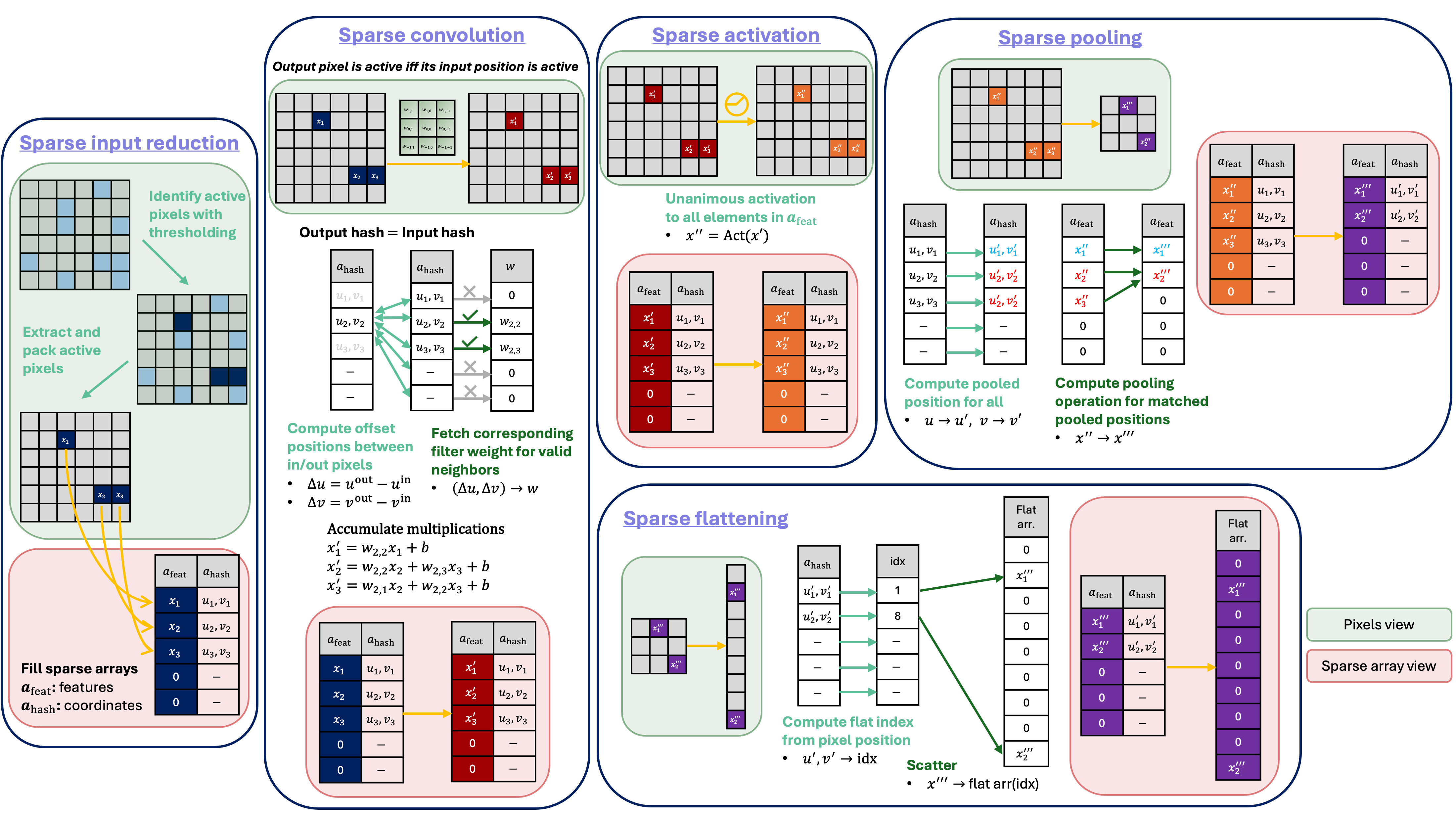
On the model training in Python, import sparse layers:
from sparsepixels.layers import *
Sparse input reduction:
x_in = keras.Input(shape=(x_train.shape[1], x_train.shape[2], x_train.shape[3]), name='x_in')
x, keep_mask = InputReduce(n_max_pixels=n_max_pixels, threshold=threshold, name='input_reduce')(x_in)
Sparse convolution:
x = QConv2DSparse(filters=1, kernel_size=7, use_bias=True, name='conv1', padding='same', strides=1,
                          kernel_quantizer=quantizer, bias_quantizer=quantizer)([x, keep_mask])
Sparse pooling:
x, keep_mask = AveragePooling2DSparse(4, name='pool1')([x, keep_mask])
We are working on hls4ml integration that auto parses the sparse layers into HLS.
If you find this useful in your research, please consider citing:
@article{Tsoi:2025nvg,
    author = "Tsoi, Ho Fung and Rankin, Dylan and Loncar, Vladimir and Harris, Philip",
    title = "{SparsePixels: Efficient Convolution for Sparse Data on FPGAs}",
    eprint = "2512.06208",
    archivePrefix = "arXiv",
    primaryClass = "cs.AR",
    month = "12",
    year = "2025"
}