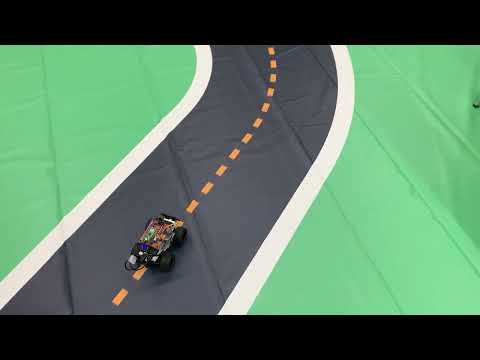
In order to train the DeepPicar models the following Python modules are required:
$ pip install tensorflow numpy pandas scikit-learn opencv-python tensorflow-model-optimization tqdm
The model architecture can be set by changing the modelname field in any params.py:
modelname = "pilotnet"
For example, to train the PilotNet model with Depthwise Separable layers, change "pilotnet" to "pilotnet_depthwise".
We assume that all datasets are located in a directory named "Dataset/" with the following structure:
```
Dataset
|____<dataset #1>
|	|____<epoch #1>
|	|	|	out_video.avi
|	|	|	out_key.avi
|	|____<epoch #2>
|	|	...
|____<dataset #2>
|	...
```
The dataset used for training can then be changed in any params.py::
dataset="<dataset #1>" # Replace with actual dataset name
The datasets used to train the models in the paper can be found at:
- Real-world dataset: https://drive.google.com/file/d/1Fjwy-dLDp5sNilPTUMXUkmnUF1SrXDOl/view
- Udacity simulator dataset: https://drive.google.com/file/d/1WW0r-Zx0_sPULpsV_44i-M1zZhQwX6ao/view
To create both Keras and TFLite models for the chosen architecture, run the following:
$ python quant-train.py
To create a TFLiteMicro compatible model representation, run the following command inside the desired models directory:
$ xxd -i quant-model.tflite <model-name>.cc
Where is the name of the new file.
To perform a NAS for a given model backbone/dataset combination, the following commands can be run:
$ python filter_models.py <max_MACs>
$ python train_pass.py
$ ./create-cc.sh <dataset_name>
Note: The NAS process can be resource intensive in terms of system and GPU memory. In the paper, we used a PC with 64GB of system memory and a GPU with 10GB of memory.
Detailed instructions can be found in the Pico directory.
Detailed instructions can be found in the UdacitySim directory.
If you have found our work useful, please consider citing:
@inproceedings{bechtel2022deeppicarmicro,
  title={{DeepPicarMicro: Applying TinyML to Autonomous Cyber Physical Systems}},
  author={Bechtel, Michael and Weng, QiTao and Yun, Heechul},
  booktitle={2022 IEEE 28th International Conference on Embedded and Real-Time Computing Systems and Applications (RTCSA)},
  pages={120--127},
  year={2022},
  organization={IEEE}
}